Why Most Sales Emails Get Deleted in 3 Seconds (And How to Fix Yours)
You hit send. You wait. Nothing.
No reply. No click. Not even an “unsubscribe.” Just silence — and a prospect who moved on before they ever gave you a real chance. It stings, doesn’t it?
Here’s the hard truth: most sales emails are deleted within 3 seconds of being opened. Sometimes less. And the reasons aren’t random — they’re predictable, fixable, and costing you real money every single day.
Let’s talk about what’s actually going wrong, and more importantly, what you can do about it right now.
Why Do People Delete Sales Emails So Quickly?
People aren’t deleting your email because they’re rude. They’re deleting it because nothing caught their attention fast enough to justify their time. That’s the brutal math of the inbox.
According to Statista, nearly 46% of all email traffic is spam. Your prospects have trained themselves to scan and dismiss — fast. If your email looks, feels, or reads like noise, it’s gone.
The delete decision happens in the preview pane, before a single sentence of your body copy is read. The subject line, the sender name, and the first visible line of text do all the heavy lifting.
The 5 Reasons Your Sales Emails Get Deleted
1. Your Subject Line Sounds Like a Sales Email
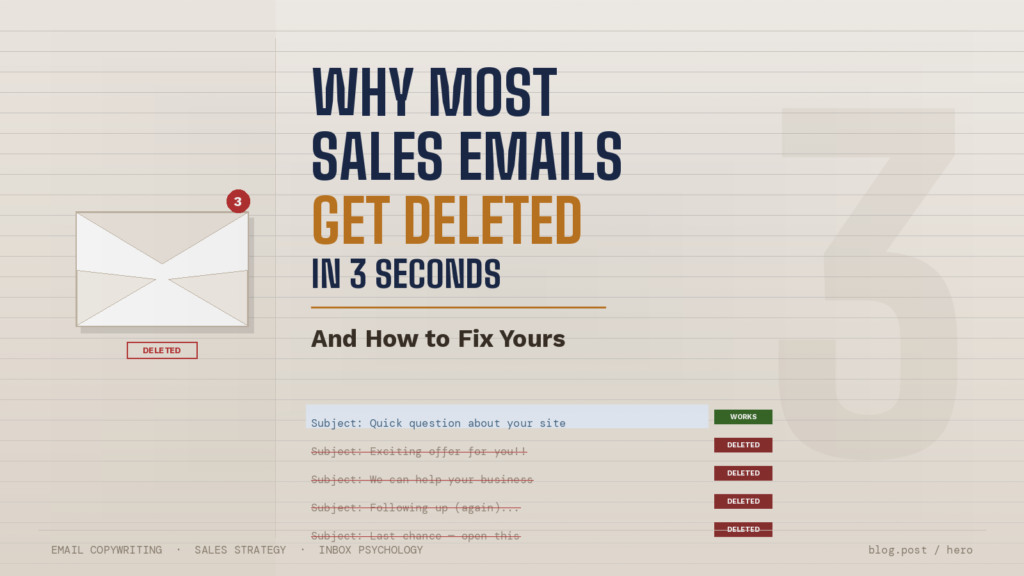
This is the single biggest killer. Subject lines like “Exciting opportunity for your business!” or “We can help you grow” are red flags to any experienced buyer. They trigger skepticism before the email is even opened.
Mailchimp’s research shows that personalized, specific subject lines consistently outperform generic ones. Curiosity, specificity, and relevance are what drive opens — not excitement or enthusiasm.
Write subject lines that feel like they came from a real person. Short, direct, and human. Think: “Quick question about [their company]” or “Noticed something on your website.”
2. The Opening Line Screams “Me, Me, Me”
Too many sales emails open with: “Hi, I’m [Name] from [Company], and we specialize in…” Nobody asked. Nobody cares. Not yet, anyway.
Your reader’s first instinct is self-preservation. They’re thinking: “What’s in this for me?” If your opener doesn’t answer that within the first line or two, you’ve already lost them.
Start with them. Reference something real — a post they published, a challenge in their industry, a recent company milestone. Show them you did your homework before you asked for anything.
3. There’s No Relevance or Personalization
Spray-and-pray email blasts are not a strategy. They’re a shortcut that costs you credibility. When a prospect can tell your email was sent to 5,000 people with a name swap, they don’t feel valued — they feel targeted.
McKinsey & Company found that personalization can deliver five to eight times the ROI on marketing spend. The data is clear — relevance wins. Generic loses.
Even one or two specific, researched details make your email feel personal. That shift from “mass email” to “real message” changes everything.
4. It’s Too Long and Too Dense
People don’t read email. They scan it. If they see a wall of text, they close it. Full stop.
Short sentences. White space. One idea per paragraph. These aren’t stylistic preferences — they’re survival tactics for the inbox.
Boomerang’s analysis of email length found that emails between 50 and 125 words had response rates above 50%. Keep it tight. Say more with less.
5. There’s No Clear Call to Action
Vague endings kill momentum. “Let me know if you’re interested” puts all the work on the reader. They won’t do it.
Your CTA should be one specific, low-friction ask. Not a pitch. Not a proposal. A next step. “Are you open to a 15-minute call this week?” is clear, easy, and actionable. That’s what moves people forward.
How to Write Sales Emails That Actually Get Read
Nail the Subject Line First
Treat your subject line like the headline of an ad. It has one job: earn the open. Use the prospect’s name, their company, or a specific pain point they recognize.
Avoid ALL CAPS, excessive punctuation, and spam trigger words. HubSpot’s deliverability guide outlines exactly which words and tactics hurt your inbox placement before a human even sees your email.
Test two or three subject line variations if you’re sending at scale. Small tweaks in wording can double your open rates.
Open With a Hook, Not a Bio
Your first sentence should make them feel seen. Reference something real and specific. A recent LinkedIn post. A challenge common in their industry. A result you helped a similar company achieve.
The goal isn’t to flatter — it’s to demonstrate relevance. Prove that this email was written for them, not recycled for thousands.
Make the Value Instantly Clear
After your hook, you have one to two sentences to explain why this matters. Be direct. What problem do you solve? What outcome can they expect?
Avoid buzzwords and industry jargon. Use plain language. If your grandmother couldn’t understand the value you’re offering, rewrite it.
Keep It Under 150 Words When Possible
Brevity signals confidence. A short email says: I respect your time, and I know exactly what I want to say. A long email says: I’m not sure what matters, so I included everything.
Trim ruthlessly. Cut any sentence that doesn’t move the reader toward your CTA. If it’s not earning its place, it’s hurting you.
End With One Easy Ask
Close with a single, specific question. Make it easy to say yes — or even no. A clear response option is infinitely better than ambiguity that leads to silence.
Try: “Would it make sense to connect briefly this week?” That’s it. Simple, direct, and respectful of their decision-making power.
What’s the Best Time to Send a Sales Email?
Timing matters more than most people realize. Campaign Monitor’s research points to Tuesday through Thursday mornings — between 9 AM and 11 AM — as the sweet spot for B2B email opens.
Avoid Mondays (inbox chaos) and Fridays (mentally checked out). Midweek sends tend to catch people when they’re in decision-making mode rather than firefighting mode.
That said, test your specific audience. Every list behaves differently. Let data guide your schedule, not assumptions.
How Many Follow-Ups Should You Send?
Most sales happen in the follow-up — not the first email. Salesforce’s State of Sales report found that it often takes six to eight touchpoints before a prospect converts. One email is rarely enough.
A sequence of three to five emails — spaced three to five days apart — is a solid starting point. Each follow-up should add new value, not just repeat your original pitch.
Don’t guilt-trip. Don’t beg. Just stay relevant, stay persistent, and give them a clear reason to respond each time.
The Bottom Line
Your prospects aren’t ignoring you because they don’t need what you offer. They’re ignoring you because your email hasn’t given them a reason to stop and listen.
Fix the subject line. Open with their world, not yours. Make the value crystal clear. Keep it short. End with one easy ask.
That’s not a formula — it’s respect. And when people feel respected, they respond.
The best sales email isn’t the cleverest one. It’s the one that feels like it was written by a real person, for a real person, about a real problem. Start there, and everything else gets easier.
Now go back to your last three email drafts. Apply these principles. Then hit send — and this time, wait for something different.