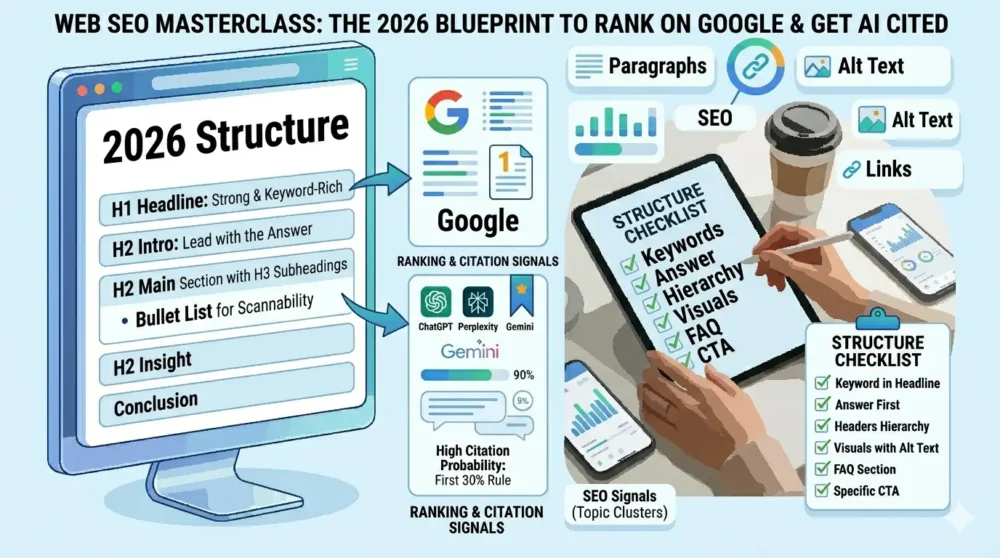
What Makes a Blog Post Rank on Google AND Get Cited by AI in 2026?
Here is the exact 8-part blog post structure that gets you found on Google, ChatGPT, and Perplexity — all at once.
Most blogs fail not because the writing is bad. They fail because the structure is wrong. Google can’t reward what it can’t read. AI engines can’t cite what they can’t extract. Fix the structure, and everything else follows.
According to Position Digital, 44.2% of all AI citations come from the first 30% of your article. If your opening buries the answer, AI engines skip you entirely.
On the Google side, Search Engine Land reports that over 65% of searches now end without a single click. The answer appears directly on the results page — pulled from well-structured blogs like the one you’re about to build.
This guide breaks down the complete framework. Use it every time you publish.
Does Blog Post Structure Really Affect Rankings?
Yes — more than most bloggers realize.
Backlinko found that the average first-page Google result exceeds 1,400 words and uses a clear header hierarchy throughout. But length without structure is just noise.
Ahrefs confirms that content organized into logical, scannable sections earns more backlinks, longer read times, and higher rankings than dense, unformatted writing. Structure is not cosmetic. It is a ranking signal.
The Best Blog Post Structure for SEO, GEO, and AIEO in 2026
1. A Headline That Stops the Scroll
Your headline does three jobs: earns the click, signals the topic to search engines, and sets expectations for AI engines pulling answers.
Moz recommends keeping your title tag under 60 characters and placing your primary keyword near the front. Beyond the technical side, your headline needs emotional pull.
- Weak: Tips for Better Blog Writing
- Strong: How to Structure a Blog Post That Actually Gets Found
One communicates. The other compels. Write the second kind — always.
2. An Introduction That Leads With the Answer
Most introductions waste the reader’s first 30 seconds with background they didn’t ask for. Flip the script. State the answer up front, then unpack the why and how.
HubSpot’s content research consistently shows that posts with a clear “answer first” structure outperform slow-build introductions in time-on-page and conversion rates. Position Digital’s AI data confirms that AI engines draw the majority of citations from your opening paragraphs.
Answer fast. Hook deep. Then deliver.
3. Header Hierarchy That Guides Both Readers and Crawlers
Think of your headers as a table of contents that both humans and machines read before diving in.
Google’s Search Central documentation is clear: use one H1 per page (your title), H2s for major sections, and H3s for subtopics within those sections. This hierarchy helps crawlers map your content and helps AI systems extract structured answers for featured snippets and AI Overviews.
Every H2 should answer a question your reader is already typing into Google.
4. Short Paragraphs and Scannable Lists
Online readers do not read. They scan.
Nielsen Norman Group — one of the most-cited UX research organizations in the world — found that users read only 20–28% of the words on a page. They skim for signals: bold text, headers, bullets, and short sentences.
Keep paragraphs to 2–3 sentences. Use bullet points for grouped information, step-by-step instructions, or comparison lists. They also improve your chances of appearing in Google’s featured snippets, which AI Overviews frequently pull from.
5. Visuals That Reinforce the Content
Images, infographics, and embedded videos do more than break up text. They extend the time readers spend on your page — a behavioral signal Google uses to evaluate content quality.
A BuzzSumo study found that articles with relevant visuals receive twice as many social media shares as those without. Always add descriptive alt text to every image.
Alt text improves accessibility, helps Google understand image context, and strengthens your on-page SEO — three wins with one habit.
6. Original Insight and Personal Experience
This is the differentiator that content farms cannot fake.
When I started structuring posts with a clear answer in the first paragraph, my average time-on-page increased noticeably — and two posts started appearing in AI Overviews within 60 days of publishing. The shift wasn’t in the writing. It was in the structure.
Google’s E-E-A-T guidelines — Experience, Expertise, Authoritativeness, and Trustworthiness — explicitly reward content that shows first-hand experience. AI engines follow the same logic. They prioritize content that goes beyond what’s already everywhere else.
Share a real result. Challenge a common assumption. Give the honest take you’ve earned.
7. A Conclusion with One Powerful Call to Action
Your conclusion should do two things quickly: summarize the core takeaway and tell the reader exactly what to do next. One CTA. Not three. Not a vague “let us know your thoughts.”
Copyblogger has long taught that the most effective CTAs are specific, benefit-driven, and tied directly to the content just consumed. Match your CTA to the reader’s intent, and conversion follows.
8. Consistent Formatting from Top to Bottom
Consistency signals credibility. Erratic formatting — mismatched headers, random bold text, varying paragraph lengths — creates friction that makes readers bounce.
Yoast SEO scores readability as a core ranking factor. Consistent structure also makes your content easier to repurpose across social media, newsletters, and email sequences without rebuilding everything from scratch.
Build a template. Stick to it. Every post, every time.
How Do You Get Your Blog Cited by ChatGPT and Perplexity?
Position Digital’s AI SEO research shows that distributing content across multiple high-authority publications increases AI citations by up to 325% compared to publishing only on your own site.
The top five factors driving AI citations are domain authority, high-quality backlinks, mentions in listicles, total backlink count, and number of unique referring domains.
Practically, this means:
- Publish on high-DA platforms like Medium (DA 96) and LinkedIn Articles (DA 99) to extend reach and earn citations
- Use FAQ-style headings — these map to the FAQPage schema that AI systems prefer
- Write in clear, direct sentences — avoid hedging language and vague phrasing
- Link to credible sources — AI systems trust content that references trusted data
- Build topic clusters — interlink related posts so AI engines recognize your topical authority. If you are still laying the groundwork, start with the essentials of blogging before scaling your structure strategy.
What’s the Ideal Blog Post Length in 2026?
- Competitive keywords: 1,500–2,500 words minimum
- Comprehensive guides: 2,500–4,000 words
But here’s the real rule. Neil Patel says a blog post is an appreciating asset — after 12 months, each post generates 60% more traffic than it did in its first six months. Length matters less than depth, consistency, and strategic updates over time.
Write to fully answer the question. Not to hit a word count.
Frequently Asked Questions About Blog Post Structure
Q: Does blog post structure really affect Google rankings? Yes. A clear header hierarchy, short paragraphs, and scannable lists all signal content quality to Google’s crawlers. Structure helps both humans and machines navigate your content faster — which directly impacts rankings.
Q: How do I get my blog post cited by ChatGPT or Perplexity? Lead with the answer in your introduction, use FAQ-style headings, write in direct sentences, cite credible sources, and publish on high-DA platforms. AI engines prioritize content that is structured, authoritative, and easy to extract.
Q: What is the best blog post length for SEO in 2026? For competitive keywords, aim for 1,500–2,500 words. For pillar content and comprehensive guides, 2,500–4,000 words. Depth and structure always outperform raw word count.
Q: How many headings should a blog post have? Use one H1 (your title), multiple H2s for major sections, and H3s for subtopics. Every H2 should address a question your reader is already searching for.
Q: Should I use bullet points in blog posts? Yes. Bullet points improve scannability, increase time-on-page, and improve your chances of appearing in Google’s featured snippets — which AI Overviews frequently pull from.
Blog Post Structure Checklist (Save This)
Run through this before every publish:
- Primary keyword in headline and first 100 words
- Answer stated clearly in the introduction
- One H1, multiple H2s and H3s throughout
- Paragraphs of 2–3 sentences maximum
- At least one scannable list or bullet section
- Images with descriptive alt text
- Original insight or personal experience included
- FAQ section with 3–5 questions
- One specific, benefit-driven CTA at the end
- Meta description under 155 characters
- Short, keyword-rich URL slug
- At least 2–3 links to high-authority external sources
Final Word
The bloggers winning in 2026 are not just good writers. They are strategic ones.
Structure is the bridge between what you know and what your audience — and AI engines — can find. Every heading, paragraph break, and external link is a deliberate signal of quality and authority.
Get the structure right, and your content doesn’t just rank. It compounds.
Want to write blog posts that rank and get cited by AI — without starting from scratch every time? Download my free Blog Post Structure Template at patrickmumo.com and publish your next post with confidence.


