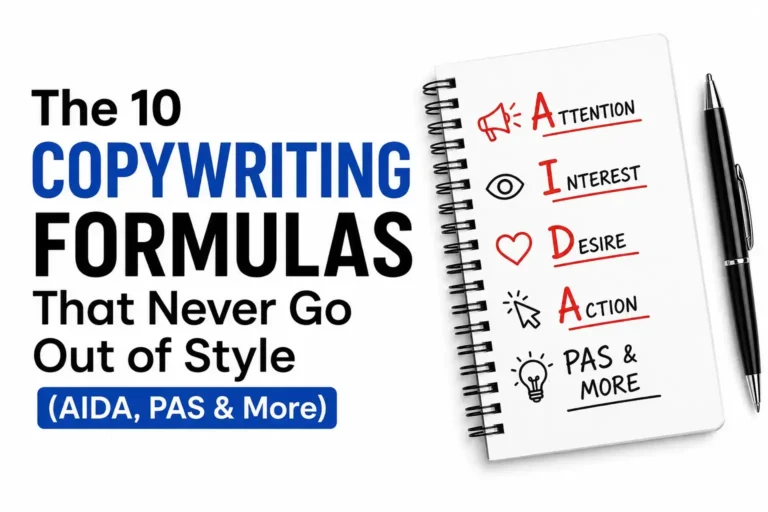
Copywriting formulas are proven text structures — like AIDA (Attention, Interest, Desire, Action) and PAS (Problem, Agitate, Solution) — that guide a reader from not caring to taking action. They work because they mirror how people naturally process persuasion: notice, understand, want, act. Below is a breakdown of the formulas that matter most, grouped by where you’d actually use them, plus a quick-reference table for picking the right one fast.
Staring at a blank page is the worst part of writing copy. You know you need to grab attention, build desire, and get the reader to act — but where do you start? A good formula removes that guesswork. It isn’t a shortcut to lazy writing; it’s a proven skeleton that has converted readers for over a century, refined by direct-response copywriters who tested it on real audiences and real money.
Here’s every formula worth having in your toolkit, when to reach for each, and how to choose between them.
Quick-Reference Table
| AIDA | General sales pages, ads | Attention → Interest → Desire → Action |
| PAS | Pain-driven offers (health, finance) | Problem → Agitate → Solution |
| FAB | Product descriptions | Features → Advantages → Benefits |
| 4 Ps | Sales pages with room to build a case | Promise → Picture → Proof → Push |
| BAB | Emails, short-form nurture copy | Before → After → Bridge |
| QUEST | Cold or skeptical audiences | Qualify → Understand → Educate → Stimulate → Transition |
| Star-Story-Solution | Case studies, testimonial-driven copy | Star → Story → Solution |
| PASTOR | Long-form sales letters | Problem → Amplify → Story/Solution → Transformation → Offer → Response |
| 4 U’s | Headlines | Useful, Urgent, Unique, Ultra-specific |
| PPPP | Ads (Facebook, Google) | Picture → Promise → Prove → Push |
| ACCA | Complex/unfamiliar products | Awareness → Comprehension → Conviction → Action |
The Classic All-Purpose Formulas
AIDA (Attention, Interest, Desire, Action)
The original, and still the most widely taught, copywriting formula. According to copy strategists, advertising executive Elias St. Elmo Lewis formally documented it in 1898— meaning the underlying psychology has guided persuasive writing for well over a century.
- Attention — a hook that stops the scroll
- Interest — details that keep them reading
- Desire — connect the product to something they want
- Action — tell them exactly what to do next
AIDA works for almost any format because it mirrors the natural arc of a decision: notice, engage, want, act.
PAS (Problem, Agitate, Solution)
PAS is the copy formula that needs urgency. You name the problem your reader has, agitate it so they feel the real cost of leaving it unsolved, then present your product as the solution. Direct-response veterans have long called PAS one of the most reliable sales formulas ever built, and it’s especially effective in health, wellness, and any niche where the reader is already in pain and needs permission to act — which is exactly the audience high-converting sales copy is designed to move.
FAB (Features, Advantages, Benefits)
FAB is translation, not persuasion. State a feature, explain what it does, then connect it to what it means for the reader’s life. It’s the formula that turns “12-hour battery life” into “work a full day without hunting for an outlet.”
The 4 Ps (Promise, Picture, Proof, Push)
Open with a big promise, paint a vivid picture of life after that promise is delivered, back it with proof, then push the reader to act. This shines on sales pages where you have room to build a full case.
Formulas Built for Email and Newsletters
BAB (Before, After, Bridge)
Show the reader’s painful “before” state, paint the transformed “after,” then position your offer as the bridge between the two states. BAB is a favorite for email sequences because it’s compact and emotionally direct.
QUEST (Qualify, Understand, Educate, Stimulate, Transition)
A slower, more consultative formula: qualify the reader, show you understand their situation, educate them, stimulate interest, and only then transition to an offer. Well suited to nurture sequences where trust matters more than a quick close.
The One Idea Rule
Not technically a formula, but it belongs here: one email, one idea, one call to action. Most weak email copy fails not because the writing is bad, but because it tries to do too much at once.
Formulas for Long-Form Sales Letters
Star-Story-Solution
Introduce a compelling character (the “star”), tell their story — usually a struggle that turns into a triumph — then reveal your product as the solution that made it possible. This works because stories are inherently more persuasive than direct claims.
PASTOR (Problem, Amplify, Story/Solution, Transformation, Offer, Response)
Think of PASTOR as PAS stretched into a full sales letter. It adds a transformation section, a clear offer, and an explicit call for the reader’s response — a complete structure for pages doing heavy persuasive lifting.
Formulas for Headlines
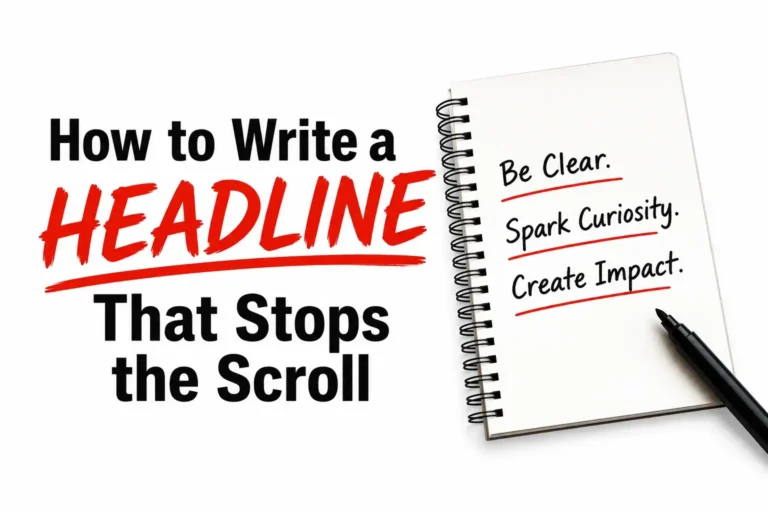
The 4 U’s (Useful, Urgent, Unique, Ultra-specific)
Not a full copy structure — a filter. Run any headline through it: is it useful, does it feel urgent, is it unique, is it specific enough to be believable? Headlines that hit all four tend to outperform generic ones by a wide margin.
Formulas for Short, Punchy Copy
PPPP (Picture, Promise, Prove, Push)
A close cousin of the 4 Ps, phrased with more punch. The formula is Common in Facebook and Google ad copy, where you have only seconds to make your case.
ACCA (Awareness, Comprehension, Conviction, Action)
A slower build than AIDA, useful when your audience needs more education before they’re ready to buy — think complex products or unfamiliar categories.
Which Formula Should You Actually Use?
With this many options, the real skill isn’t memorizing every formula — it’s matching the right one to the job:
- Selling a transformation (weight loss, financial freedom, a lifestyle change)? Reach for PAS or BAB.
- Writing a general sales page? AIDA or the 4 Ps will carry you.
- Nurturing a cold or skeptical audience? QUEST builds trust before it asks for anything.
- Writing a headline, no matter what formula you used for the body? Run it through the 4 U’s as a final gut-check.
None of these formulas is magic on its own. The psychology behind the formulas makes them work. These formulas follow the natural arc of how a person moves from not caring to curious to convinced to acting. For a deeper look at why that arc matters more than the words themselves, see why high-converting sales copy actually works. For a more technical breakdown of AIDA and PAS with real-world examples, Copyhackers’ guide to copywriting formulas is one of the most cited resources in the copywriting industry.
Frequently Asked Questions
What is the most effective copywriting formula? There’s no single “best” formula — it depends on the reader’s awareness level. AIDA works well for cold audiences who don’t yet know they have a problem; PAS works best when the reader already feels the pain; BAB is efficient for short-form email copy.
What’s the difference between AIDA and PAS? AIDA builds desire gradually through four stages (Attention, Interest, Desire, Action) and suits audiences unfamiliar with the problem. PAS moves faster by naming a problem the reader already feels, agitating it, then solving it — making it more direct and urgency-driven.
Can I combine copywriting formulas? Yes. Many high-performing sales pages layer formulas — for example, using AIDA for the overall page flow while using the 4 U’s to sharpen the headline, or nesting a BAB story inside a PASTOR-structured letter.
Do copywriting formulas still work in 2026? Yes. Formulas aren’t gimmicks. They’re structured maps of persuasion psychology: attention, emotion, proof, action. That sequence is how human decision-making works, and it hasn’t changed with a single platform update.
What changes is the medium they’re deployed on — social captions, AI search snippets, video scripts. The wrapper evolves. The underlying logic doesn’t.
Master the formula once, and you can adapt it anywhere the attention economy sends you next.
Looking for copy that’s built around these formulas and matched to your offer? See how Patrick approaches high-converting sales copy or get in touch.